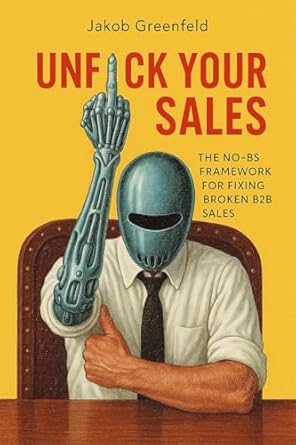
My Thoughts
Another banger by Jakob. If you are on your sales journey, do yourself a favor and read this. It’s free.
Summary
B2B sales is a simple system with one constraint at a time, read through inversion: stop asking for clever tactics and start eliminating obvious mistakes.
A company buys only when the right people have your attention at the right time and trust you enough to act.
The practical “map” is four bottlenecks:
- Reach - earning deliberate attention before you “optimize conversion”: your market is a spreadsheet of specific companies and 1–3 real humans per account, not a vague TAM. Build a hit list from non-negotiables proven by closed deals, then use channels you can verify deliver (cold email, manual DMs, phone, account-based ads) and saturate the list before iterating.
- Resonance - message buyers can repeat in five seconds: name the painful problem, the concrete outcome, and the mechanism—simply, in their words, consistently.
- Timing - engineered presence, not funnel gymnastics: only ~5% are ready now, so remind every buyer you exist every 4–6 weeks to build “digital gravity” and be top-of-mind when pain spikes.
- Trust - if qualified close rate is under ~30%, you lack evidence, not confidence—buyers book calls to confirm after they’re already deep into the process and choose what feels safest. Build layered proof across touchpoints (case studies, specific testimonials, screenshots, third-party mentions), remove friction (simple offer, clear pricing, obvious next steps), and use repetition across platforms until familiarity makes saying yes low-risk.
The “compass” is the Theory of Constraints: find the single Herbie dragging your pipeline (invisibility, wrong buyers, weak clarity, low trust) and ignore everything else until it’s fixed.
Learnings
- Sales is constrained by one bottleneck at a time; find the “Herbie” (attention, resonance, timing, or trust) and fix that before optimizing anything else.
- Use inversion as the lens: stop asking “what’s smartest?” and instead eliminate the obvious mistakes causing invisibility, confusion, bad timing, or low credibility.
- Companies buy when the right people have attention on you at the right time and trust you enough to act; missing any one of these breaks the system.
- Reach comes first: you can’t claim rejection until you’ve deliberately put your name in front of every real buyer in your market at least once.
- Your “market” is a small list of specific companies and 1–3 real humans inside each; treat it like a spreadsheet/hit list, not a vague TAM.
- Avoid reach extremes: don’t “starve” via over-targeting/perfectionism, and don’t “binge” via blasting noise to unqualified buyers; define who must know your name or you don’t eat.
- Build your list from proof: derive non-negotiable criteria from closed deals (yours or competitors’) and use the minimally sufficient filters to include all viable accounts.
- Use channels where you control delivery (cold email, manual DMs, account-based ads to your list, phone) rather than hoping brand/algorithms deliver.
- Saturate before you optimize: until every buyer on the list has seen you once, you don’t have a real feedback loop—finish the first pass.
- Resonance means instant clarity: obvious who it’s for, what pain you solve, what outcome they get, and the mechanism; complexity is usually insecurity.
- Distinctiveness beats “uniqueness”: be easy to notice/recall and strongly associated with a specific pain and outcome; repeat the same clear message consistently.
- Timing is engineered presence: buyers purchase when pain spikes, so build “digital gravity” through consistent reminders, not funnel tinkering or one-off bursts.
- Only ~5% are ready now; you win by building mindshare with the 95% so you’re first call when timing flips.
- Trust is the final constraint: if qualified leads don’t close (e.g., <30%), the issue is evidence and risk—not more attention or better follow-up.
- B2B buyers choose “safe” over “best”: they book calls to confirm (already deep in buying), and they trust proof (pattern recognition) more than confidence.
- Trust compounds via layered exposure: aim for substantial interaction across many touchpoints/platforms, lead with case studies/testimonials/data/third-party credibility, and remove friction with simple offers, clear pricing, and obvious next steps.
‘How to Read a Book’ Analysis
Key Sentences
-
“Companies buy when you have the attention of the right people, at the right time, and they trust you enough to take action.”
- Why it’s crucial: It compresses the entire sales system into three constraints—reach, timing, and trust—so you know what must be true before anything closes.
- Proposition: Sales performance is primarily a constraint-management problem: create attention with the right buyers, stay present until the buying window opens, and accumulate enough trust to trigger action.
-
“Every system is limited by one key constraint.”
- Why it’s crucial: It prevents scattered optimization and forces focus on the single bottleneck that is actually throttling results.
- Proposition: Don’t improve everything—identify the “Herbie” in your pipeline and concentrate resources on fixing it before touching secondary metrics.
-
“Until you’ve deliberately and directly put your name in front of everyone in your actual market, at least once, you can’t claim rejection.”
- Why it’s crucial: It reframes “market response” as a coverage problem; you can’t interpret silence as rejection if you haven’t achieved true reach.
- Proposition: Saturation precedes optimization: build a finite hit list of real buyers and ensure provable first contact with all of them before iterating messaging or funnels.
-
“Your message has to answer three questions instantly: What painful problem do you solve? What outcome do I get? How do you get me there?”
- Why it’s crucial: It defines resonance as immediate comprehension, not cleverness, and supplies a testable structure for messaging.
- Proposition: Effective positioning is a simple triad—pain → concrete outcome → mechanism—expressed in buyer language and repeated consistently until recall becomes automatic.
-
“B2B buyers don’t trust confidence. They trust evidence.”
- Why it’s crucial: It identifies trust as the final bottleneck and clarifies that proof (not persuasion) is what reduces perceived risk and prevents ghosting.
- Proposition: Winning B2B deals requires risk mitigation via layered proof—case studies, specifics, third-party credibility, and repeated multi-platform exposure—so the buyer can safely “confirm,” not “explore.”
Unity of the Book
Sales works by systematically removing the single biggest constraint—first earning controlled attention from a finite list of real buyers, then creating clear pain-linked resonance, engineering consistent presence for timing, and layering proof to build trust—so the right people buy at the right moment with minimal perceived risk.
Author’s Problems
Main Problem
How can a B2B company reliably generate more sales by diagnosing and fixing the single biggest constraint in its sales system (attention, resonance, timing, or trust) instead of chasing tactics and “optimizing” the wrong things?
Supporting Problems
- Why do teams try to improve conversion, persuasion, positioning, or funnels before they’ve earned basic attention from the right buyers?
- How do you define a “market” as a finite, reachable list of real companies and specific buyers (a hit list), rather than an abstract TAM?
- What are the most common failure modes in reach (over-precision/“starving” vs over-volume/“bingeing”), and how do you avoid both?
- How do you discover the minimally sufficient “non-negotiable” criteria for targeting based on proof from closed deals (yours or competitors’)?
- Which outreach channels actually provide controlled, provable delivery to qualified buyers (vs brand-only or hope-based channels)?
- How do you know whether your message resonates—i.e., buyers can quickly recall who you are, what you do, and the pain/outcome you own?
- Why does messaging fail due to vagueness, abstraction, and complexity, and how do you make it blunt, repeatable, and buyer-native?
- How should a message be structured so a buyer gets it in seconds (pain → concrete outcome → mechanism)?
- Why do deals get lost before you’re even considered (shortlists), and how do you become distinctive and memorable rather than “unique”?
- Why is timing not something you “detect” via intent, but something you engineer through consistent presence and repetition?
- How do you overcome the fear of “annoying” prospects and replace it with a cadence that builds memory (e.g., reminders every 4–6 weeks)?
- Why is a low close rate on qualified leads usually a trust constraint, and how do you diagnose it (ghosting, “sounds good” then vanish)?
- What builds B2B trust (evidence and risk reduction) versus what destroys it (confidence, hype, loud pitching without proof)?
- How do buyers actually make decisions (safe > best; minimizing regret), and how should sales adapt to that?
- What does “enough trust” statistically require (multi-hour, multi-touchpoint, multi-platform exposure), and how do you design for it?
- How do you reduce friction that blocks trust and action (simple offer, sharp pitch, clear pricing, obvious next steps)?
- How do you build “digital gravity” (ongoing mindshare with the 95% not ready now) rather than obsessing over funnel optimization?
Problem Hierarchy
- Core constraint question: What is the single bottleneck currently throttling sales?
- If the constraint is Reach (Attention)
- Can we name every real buyer who must know us or we don’t eat?
- Have we built a proof-based hit list (companies + 1–3 real humans each)?
- Are we using delivery-controlled channels (email/DM/ABM ads/phone)?
- Have we saturated the list at least once before “optimizing”?
- If the constraint is Resonance (Clarity + Recall)
- Do buyers instantly understand who it’s for, what pain it solves, and what outcome they get?
- Can the market recall us in a “mindshare check” for the category/problem?
- Is our message simple, blunt, and repeatable (pain → outcome → mechanism)?
- Are we building distinctiveness (easy to notice/remember) rather than chasing uniqueness?
- If the constraint is Timing (Engineered Presence)
- Are we consistently showing up so we’re remembered when pain spikes?
- Do we maintain a reminder cadence (every 4–6 weeks) across the market?
- Are we prioritizing mindshare with the 95% not ready now over forcing the 5%?
- Are we expanding only after earning mindshare in the proven TAM?
- If the constraint is Trust (Proof + Risk Reduction)
- Is the close rate on qualified leads ≥ ~30%, or are we seeing ghosting/drop-off after interest?
- Do we lead with evidence (case studies, specifics, dashboards, third-party proof) over promises?
- Are we accumulating layered exposure across touchpoints and platforms to reach trust thresholds?
- Have we removed friction (simple offer, clear pricing, crisp process, obvious next steps) so “safe to say yes” is easy?
- If the constraint is Reach (Attention)
Prompt / Agent Ideas
1) Constraint Finder (Herbie)
Goal: Identify the single biggest bottleneck in your sales pipeline (attention, resonance, timing, or trust) and the next best action.
Inputs:
- Current pipeline metrics (last 30–90 days)
- Funnel stages + conversion rates
- Notes on lost deals / ghosting reasons
- Your current ICP/list criteria
Outputs:
- The “one constraint” diagnosis (with evidence)
- 3 highest-leverage fixes (in priority order)
- A 14-day execution plan with daily actions
Prompt skeleton: You are my sales ops analyst using Theory of Constraints and inversion. Context: [briefly describe product, price, market]. Data:
- Stages + conversion rates: [paste]
- Volume by stage: [paste]
- Last 20 lost/ghosted reasons: [paste] Task:
- Identify the single biggest constraint limiting revenue (choose only one): Attention, Resonance, Timing, or Trust.
- Show your reasoning using the data above.
- Propose 3 fixes ranked by leverage and speed.
- Create a 14-day plan with daily actions and a simple success metric for each day. Output in a table.
2) Non‑Negotiables Extractor (Proof-Based ICP)
Goal: Derive minimally sufficient ICP criteria from real closed deals (not opinions).
Inputs:
- A CSV/paste of closed-won deals (10–50+)
- Deal notes (why they bought)
- Firmographics/technographics fields you have
Outputs:
- 3–7 non-negotiable criteria
- “Violations list” (who to exclude)
- A shortlist of ICP variants to test
Prompt skeleton: Act as a B2B revenue analyst. I will paste closed-won deal data. Data fields: [list fields]. Closed-won deals: [paste rows]. Task:
- Infer the non-negotiable criteria that appear necessary for a deal to close (aim for 3–7).
- Separate “nice-to-have” from “must-have.”
- Write the criteria as filter rules I could apply in a spreadsheet/CRM.
- Provide an exclusion list: patterns that correlate with churn, long cycles, or no-decision. Format: bullets + a final criteria checklist.
3) Hit List Builder (Spreadsheet Market)
Goal: Turn your TAM into an actionable list of named accounts + 1–3 buyer humans per account.
Inputs:
- Non-negotiable criteria (from idea #2)
- Target region/language constraints
- A source list (LinkedIn search results, directories, competitor customer list, etc.)
- Buyer titles/pain roles you sell to
Outputs:
- A deduped account list (with confidence scores)
- Buyer personas mapped to “feels the pain + can act”
- A contact strategy per account (who first, who second)
Prompt skeleton: You are my ABM list-building assistant. Criteria (non-negotiables): [paste]. Source data (companies/leads): [paste]. Buyer roles that feel pain + can buy: [paste]. Task:
- Select only accounts that meet all non-negotiables.
- For each account, identify 1–3 likely buyer roles and the order to contact them.
- Add a confidence score (High/Med/Low) and why. Output as a table with columns: Account | Why fit | Buyer #1 role | Buyer #2 role | Buyer #3 role | Confidence | Notes.
4) Delivery-Control Channel Planner
Goal: Create a reach plan using only channels where delivery is provable (no “hope marketing”).
Inputs:
- Your hit list size
- Channels available (cold email, DMs, phone, ABM ads)
- Weekly time budget + tools you use
- Compliance constraints (GDPR, etc.)
Outputs:
- 4-week outreach plan (volume + sequencing)
- A “first pass saturation” checklist
- Minimal tracking schema (what to log)
Prompt skeleton: You are my outbound operations planner. Hit list size: [N accounts / N contacts]. Available channels (only use these): [list]. Time budget: [hours/week]. Tools: [tools]. Constraints: [GDPR/industry]. Task: Build a 4-week plan to ensure every buyer sees us at least once (“saturate before optimize”). Include: daily volumes, sequencing across channels, and what I should track. Output: a weekly calendar + a tracking template.
5) Resonance Message Builder (Pain → Outcome → Mechanism)
Goal: Generate a single blunt, repeatable message that lands in under five seconds.
Inputs:
- The buyer’s exact painful trigger (their words)
- Concrete outcome you deliver
- Your mechanism (what you actually do)
- 2–3 examples of customers/results (if any)
Outputs:
- One core positioning sentence
- 5 variations for email/DM/LinkedIn/phone opener
- A “banned words” list (fluff to avoid)
Prompt skeleton: Act as a conversion-focused messaging editor. Buyer pain (use their words): “[paste]” Outcome (concrete): [paste] Mechanism (what we do): [paste] Proof snippets (optional): [paste] Task:
- Write ONE core sentence combining Pain + Outcome + Mechanism.
- Create 5 channel variations that keep the meaning identical (email subject+first line, DM, phone opener, website hero, ad headline).
- List 10 vague/fluffy terms to avoid in our messaging. Keep everything blunt, simple, and specific.
6) Mindshare Check Agent (Resonance Test)
Goal: Run a structured “who comes to mind?” test and summarize whether you’re on the shortlist.
Inputs:
- Your category/problem phrasing
- A list of 50 target contacts (or a panel source)
- Your current messaging
Outputs:
- Survey script + outreach copy
- Results summary (top mentions, themes, gaps)
- Action plan to improve recall/distinctiveness
Prompt skeleton: You are my research assistant running a mindshare check. Category/problem phrase: [e.g., “reducing employee churn in retail”]. Audience description: [who they are]. Current message: [paste]. Task:
- Draft a 3-question micro-survey whose first question is: “When you think of [category], who comes to mind?”
- Draft the outreach message to invite 50 people (offer incentive).
- Provide an analysis framework: how to code responses, what “pass/fail” looks like, and what to change if we’re not mentioned. Output: survey + outreach + analysis rubric.
7) 4–6 Week Reminder Engine (Timing)
Goal: Maintain engineered presence so every buyer is reminded you exist every 4–6 weeks without spamming.
Inputs:
- Buyer list + tags (segment by pain/role)
- Content/proof assets you already have
- Allowed channels
- Frequency cap per person
Outputs:
- A 6-week touchpoint calendar per segment
- Touchpoint templates (short, value-forward)
- Rules for “remind vs pitch”
Prompt skeleton: You are my lifecycle touchpoint designer. Audience segments: [list segments + pain]. Channels I can use: [list]. Assets: [case studies, posts, Looms, docs]. Rules: remind, don’t pitch; frequency cap: [e.g., max 1 message/week]. Task: Create a 6-week reminder plan so each buyer gets 1–2 lightweight touches every 4–6 weeks. For each touch: objective, message template, and the asset to include. Output as a table by week and segment.
8) Trust Stack Builder (Evidence > Confidence)
Goal: Convert your “claims” into an evidence library mapped to common buyer risks.
Inputs:
- Your core claims (what you promise)
- Existing proof: testimonials, case studies, screenshots, metrics
- Common objections you hear
- Industry compliance constraints
Outputs:
- A “trust stack” matrix: claim → risk → evidence
- Gaps list (what proof you need next)
- Plug-and-play proof snippets for outbound and calls
Prompt skeleton: Act as my trust architect for B2B buyers who optimize for safety. My claims: [paste]. Objections/risks buyers mention: [paste]. Existing proof assets: [paste links/snippets]. Task:
- Build a matrix mapping each claim to the buyer risk it triggers and the best evidence to reduce that risk.
- Identify proof gaps and propose the fastest proof to create (screenshots, mini case study, benchmark, etc.).
- Write 10 “proof snippets” (1–2 sentences) I can paste into DMs/emails. Output: matrix + gaps + snippets.
9) 11 Touchpoints / 4 Platforms Planner (Trust Threshold)
Goal: Design a multi-touch trust path that hits ~7 hours, 11 touchpoints, across 4 platforms.
Inputs:
- The 4 platforms you can realistically use
- Available assets (video, posts, docs, webinars, podcasts, etc.)
- Target account list size
- Your weekly capacity
Outputs:
- A touchpoint sequence (what, where, how long)
- Asset checklist to reach ~7 hours
- A simple CRM logging scheme
Prompt skeleton: You are my multi-touch journey designer. Platforms I can use: [e.g., Email, LinkedIn, YouTube, Website]. Current assets: [list with length]. Weekly capacity: [hours]. Task:
- Create a sequence of 11 touchpoints across at least 4 platforms totaling ~7 hours of exposure.
- Each touchpoint must have: purpose (remind/prove/teach), asset, expected time spent, and CTA (if any).
- Provide a minimal logging template for CRM. Output as a numbered list + logging template.
10) Ghosting Triage Agent (Trust vs Timing)
Goal: Diagnose whether a ghosted deal is timing, trust, or mismatch—and generate a non-needy next message.
Inputs:
- Deal context + stage
- Last 5–10 messages exchanged
- Buyer role + company
- Any known objection/concern
Outputs:
- Diagnosis (most likely reason + confidence)
- 3 follow-up messages (different angles)
- A “breakup” message that preserves goodwill
Prompt skeleton: You are my deal-rescue assistant. Use inversion: assume I’m failing due to attention/timing/trust/mismatch and find the most plausible one. Deal context: [paste]. Messages so far: [paste thread]. Buyer + role: [paste]. Task:
- Diagnose the most likely reason for silence and rate confidence.
- Write 3 follow-ups (<=80 words) using: (a) proof, (b) clarity on next step, (c) timing check. No guilt, no pressure.
- Write 1 short breakup message. Keep tone professional and specific.
11) Friction Audit Checklist (Make It Easy to Say Yes)
Goal: Audit your offer/pitch/next steps for friction and ambiguity that kills trust.
Inputs:
- Your landing page copy (paste)
- Pricing page or pricing blurb
- Your standard “next steps” after a call
- Sales deck / one-pager (if any)
Outputs:
- A friction list ranked by impact
- Rewrites for clarity (shorter, sharper)
- A “next steps” script that’s obvious
Prompt skeleton: Act as a ruthless clarity editor for B2B buyers who avoid regret. Materials:
- Offer/landing copy: [paste]
- Pricing: [paste]
- Next steps: [paste] Task:
- Identify points of friction or vagueness that reduce trust (rank by severity).
- Rewrite the key sections to be dead simple (no buzzwords).
- Produce a 3-step “what happens next” script I can say on calls and paste in follow-up emails. Output: ranked list + rewrites + script.
12) Repetition without Drift (Consistency Guardrail)
Goal: Keep your message consistent across channels so you become distinctive, not “clever.”
Inputs:
- Your core message sentence (from idea #5)
- Existing outreach templates and posts
- Keywords you want to own (pain/outcome)
Outputs:
- A “message linting” rubric (pass/fail)
- Edited templates that say the same thing
- A set of reusable blocks (pain, outcome, mechanism, proof)
Prompt skeleton: You are my consistency editor. My goal is distinctiveness through repetition, not novelty. Core message (must remain consistent): [paste]. Templates/content to review: [paste]. Task:
- Create a rubric to check if a message preserves the same Pain/Outcome/Mechanism (pass/fail).
- Edit each template to align with the core message while staying natural for the channel.
- Output reusable blocks: Pain lines, Outcome lines, Mechanism lines, Proof lines (5 each). Keep language simple and direct.
Highlights
Our Map, Lens, and Compass
That’s what this book gives you.
Three tools.
• A map that lays out how sales actually works. It defines the destination. Without it, you don’t even know what you’re aiming at.
• A lens that helps you read the map the right way.
• A compass that tells you exactly where to go at every single step.
Companies buy when you have the attention of the right people, at the right time, and they trust you enough to take action.
Charlie Munger once said:
“Avoiding stupidity is more important than seeking brilliance.”
In other words: don’t start by asking, “What’s the smartest thing I could do?”
Start with:
“What obvious mistakes am I making and how do I stop?”
That’s how you start fixing what matters.
Inversion is the lens we use to read our map correctly.
It’s not about doing more.
It’s about screwing up less.
Every system is limited by one key constraint.
Not two. Not five. One.
You don’t need to optimize everything.
You need to find and fix the one thing throttling performance.
There’s always one Herbie in your pipeline.
One element dragging everything down.
Maybe no one sees you. Maybe the wrong people do. Maybe they don’t trust you.
Whatever it is, that’s the constraint.
Everything else is noise until that’s resolved.
So we invert to find what’s broken.
We use the Theory of Constraints to focus on the one thing that matters.
Then, and only then, do we improve the system.
That’s our compass.
Companies don’t buy when you fail to have attention, miss the right timing, or lack trust.
Reach
Every sale starts with attention.
Not persuasion.
Not positioning.
Not pricing.
Just attention.
If they don’t know you exist, they can’t buy. It’s that simple.
Until you’ve deliberately and directly put your name in front of everyone in your actual market, at least once, you can’t claim rejection.
stop trying to “optimize conversion” before you’ve even earned attention.
You don’t sell to “the mid-market.”
You sell to 8,431 companies.
And within each of those companies, there are maybe 1–3 people who actually feel the pain you solve and can do something about it.
So your real target isn’t “the industry.”
It’s a list of maybe a few thousand humans. Max.
That’s not a market.
That’s a spreadsheet.
So let’s invert it:
Want to stay invisible?
Just pretend your TAM is too big to reach directly.
Waste thousands running ad campaigns with broad blackbox targeting.
Act like you’re building for “the market” instead of real buyers with names, inboxes, and LinkedIn profiles.
Most teams screw up reach the same way they screw up diets: they either starve or binge.
The starving ones overthink it.
They get scared, so they get clever.
They slice their market into a hundred micro-segments. Build separate playbooks for each persona. Chase perfect targeting. Tweak subject lines for CTR. Run precision filters to death.
It feels smart. Strategic. Data-driven.
But it’s cowardice in disguise.
They spend all day picking the right match while the woodpile is soaked and no one’s gathering kindling.
They never start the fire.
Then you’ve got the binge crowd.
They hear reach is the constraint and lose their minds.
Buy bloated lead lists. Blast generic messaging. Post random memes every day hoping something lands.
They mistake noise for signal.
And fill their calendar with the wrong people — junior titles, fake intent, weak pain, no budget, no urgency.
Then they wonder why nothing converts.
Both groups are optimizing the wrong thing.
One fears being ignored. The other fears being overlooked.
You don’t win by being precise.
You don’t win by randomly being loud.
It’s not about perfect personas. It’s not about psychographic segmentation. It’s not about channel hacks.
It’s about answering one question with total certainty:
Who must know your name or you don’t eat?
That’s your bar.
Contacting a new buyer for the first time has on average a 2.6x higher ROI than following up with someone you’ve already reached.
But your real market isn’t something you imagine.
It’s something you uncover.
You don’t start with personas or market assumptions.
You start with proof.
Look at the deals you’ve already closed (or your competitors have).
You’re not looking for what’s ideal.
You’re isolating what’s necessary.
These are your non-negotiables.
Don’t overthink it. Don’t overengineer it.
Extract that minimally sufficient number of criteria that allows you to find all companies you can work with.
Once you’ve found the non-negotiable criteria, build a list that matches it.
Not based on who you think would be cool to work with.
Only companies that don’t violate any of the criteria you identified.
You’re not building a TAM slide.
You’re building a hit list.
Then go deeper:
Inside each company, name the 1–3 real humans who feel the pain and can buy.
Use only channels where you control delivery
So skip brand plays. Skip waiting. Skip hoping.
Use channels where you know the message lands:
• Cold email
• Manual DMs
• Account-based ads to your list
• Phone
No spraying. No praying.
Just deliberate, provable contact with qualified buyers.
4. Saturate before you optimize
Until every name on your list has seen you at least once, you have no feedback loop.
You’re guessing in the dark.
So ask:
“Have we reached every real buyer?”
If the answer’s no, stop everything else.
You don’t fix performance by iterating.
You fix it by finishing the first pass.
Resonance
Visibility is useless if it’s not tied to a specific pain and a clear outcome.
This is where most sales messaging dies.
Not from lack of activity.
From lack of clarity.
The offer is vague.
The pain is abstract.
The value is hidden behind clever words or fluffy positioning.
So the buyer tunes out.
That’s what resonance is:
A message that cuts through because it’s obvious who it’s for, what it solves, and why it matters.
Now it’s time to test for resonance.
Run a mindshare check.
Ask 50 randomly chosen people on your list (pay them if you have to):
“When you think of [problem or category], who comes to mind?”
If your name doesn’t show up, you’re not resonating.
This is the resonance test:
• Do the right people recognize your name?
• Can they say, in plain language, what you do?
• Do they link you to a clear, specific pain and outcome?
If your market doesn’t instantly get who you are, what you do, and why it matters, you’ve already lost.
The people who win attention aren’t smarter.
They’re braver.
Brave enough to be blunt.
To say it straight.
To repeat themselves.
Most buyers see all brands in a category as basically interchangeable.
(Coke = Pepsi. Slack = Teams. You = That Other Agency.)
What wins isn’t uniqueness.
It’s distinctiveness.
Being easy to notice. Easy to recall. Easy to associate with a specific pain.
• Own a specific outcome.
• Anchor to a painful trigger.
complexity doesn’t make the message stronger.
It makes it harder to grasp.
Complexity is a symptom of insecurity.
If you can’t explain it simply, you don’t really understand it.
Resonance comes from speaking to buyers the way they speak to each other.
If your message makes sense in the group chat or the team Slack, you’re doing it right.
92% of buyers pick from their initial shortlist.
If you’re not on it, you don’t get a shot.
Not because your offer sucks. Not because your pricing’s off. Not because your cold email didn’t land.
You just weren’t in the room when the decision was made.
Your message has to answer three questions instantly:
• What painful problem do you solve?
• What outcome do I get?
• How do you get me there?
That’s it.
If your buyer doesn’t get all three in under five seconds, the message won’t land.
So here’s how to engineer it:
1. Start with the pain.
Don’t lead with the solution. Start with what hurts. Use their words, not yours.
“Our best people keep quitting.” … If the buyer doesn’t feel it, nothing else matters.
2. Make the outcome concrete.
Say what they actually get. No abstractions.
“Retention goes up and top performers stay longer.” … No fluff. Just the result.
3. Name the mechanism.
What do you actually do to get that outcome?
“We plug into your payroll and offer personalized employee benefits through a self-serve portal.” … Now combine the pieces:
“We keep your best people from quitting by offering personalized benefits through a self-serve portal.”
Don’t rewrite the pitch for every channel.
Say the same thing, clearly and consistently, until the market finishes your sentence for you.
Timing
Buyers don’t buy when you want to sell.
They buy when they need to.
This is why “follow-up” isn’t an afterthought. It’s the game.
This is why sales isn’t about “convincing”. It’s about catching.
It’s not enough to be known.
You need to be remembered at the moment the pain spikes.
Being top-of-mind at the right moment.
Timing isn’t something you detect.
It’s something you engineer.
By showing up early.
By showing up often.
By having people’s attention before the pain hits.
Intent is a lagging indicator.
Presence is a leading one.
“We don’t want to annoy people.”
Translation:
“We’re afraid to be seen.”
Let me say this clearly:
You’re not annoying.
You’re invisible.
Nobody is sitting around feeling overwhelmed by your existence.
They’re not mad you emailed twice.
They’re not talking about your LinkedIn posts.
They don’t remember your brand or that you ever reached out.
They saw it. Maybe.
Scrolled. Deleted. Moved on.
You’re not annoying.
You’re forgettable.
You don’t get remembered by being polite.
You get remembered by showing up so consistently and clearly that they can’t ignore you.
Repetition isn’t annoying.
It’s how memory works.
Get over it.
This isn’t high school. You’re not going to die of embarrassment if someone ignores your message.
But you will lose the deal if they forget you exist.
Showing up repeatedly with clarity, value, and a clear offer?
That’s not annoying.
That’s professional.
Expansion into unproven markets only makes sense after you’ve earned mindshare across your proven TAM.
Not before.
So if you’re bored with your market, good.
It means you’re doing it right.
Obsession sells. Novelty doesn’t.
Optimizing funnels is a waste of time.
Build digital gravity.
Show up again and again.
In their inbox. On their feed. Through their peers.
With clarity. Relevance. Consistency.
Not to “convert.”
But to keep them in your orbit until the moment is right.
Because buyers don’t follow funnels.
They follow memory, timing, and pain.
So stop trying to force the funnel.
Start building digital gravity.
At any given time, only about 5% of your market is ready to buy.
Your job is to be top-of-mind when that moment hits.
That’s not about being pushy.
It’s about being present.
Not once. Repeatedly. Consistently.
Because the 5% changes all the time.
Today’s “not now” is next month’s “let’s talk.”
But only if they remember you.
Which means:
You don’t win by converting the 5%.
You win by building mindshare with the 95%, so when the pain hits, you’re the first call.
That’s the game.
But sales isn’t a sprint. It’s a marathon.
Timing is engineered presence.
Here’s the playbook:
Every 4–6 weeks, every buyer in your market must be reminded you exist.
Not pitched.
Not pushed.
Just reminded.
Trust
trust.
This is the final constraint. The last bottleneck before the close.
And it’s the most fragile.
Because attention gets you seen.
Resonance gets you interest.
Timing gets you a foot in the door.
But trust is what gets you paid.
No trust = no action. Period.
Check your last 50 qualified leads.
• How many closed?
• How many ghosted?
• How many said “sounds good”, then vanished?
If they were the right buyers, you got a foot in the door, and they didn’t close, you don’t have an attention problem.
You have a trust problem.
They didn’t believe you could deliver.
Or that it was worth the risk.
Or that it would work for them.
Trust is the final constraint.
And if your close rate on qualified leads is under 30%, this is where you’re stuck.
B2B buyers don’t trust confidence.
They trust evidence.
And the louder you pitch without proof, the more skeptical they get.
real trust doesn’t come from hype.
It comes from pattern recognition.
Buyers want to see that you’ve solved this problem before.
For people like them.
You don’t win by sounding certain.
You win by making certainty obvious.
Confidence is cheap.
Proof is rare.
Buyers don’t book calls to explore. They book calls to confirm.
Because by the time they get on that call— they’re already 70% through their buying process.
“Safe” beats “best.”
That’s the hidden rule driving B2B deals.
Buyers don’t optimize for ROI.
They optimize for minimizing regret.
B2B isn’t about ambition. It’s about risk mitigation.
You’re not selling a product.
You’re selling protection from regret.
In B2B, buyers don’t choose the best option. They choose the one that feels safest to say yes to.
Trust isn’t built in bulk.
It’s built in layers.
The research is clear:
• Buyers need 7 hours of interaction
• Spread across 11 distinct touchpoints
• On at least 4 different platforms
That’s the statistical threshold for trust.
A LinkedIn post alone won’t get you there.
Neither will a 12-step email sequence.
But a post, plus a case study, plus a podcast, plus a reply in the DMs?
That starts to pull.
Buyers need to see you’ve solved this exact problem for people just like them.
So lead with proof, not promises:
• Case studies that map 1:1 to their pain
• Testimonials with specifics, not fluff
• Screenshots and dashboards showing real outcomes
• Logo walls that signal credibility
• Third-party mentions: podcasts, press, referrals
audit every point of friction:
• Is your offer dead simple?
• Is your pitch short and sharp?
• Can they grasp pricing at a glance?
• Are next steps obvious?
Trust isn’t built in the meeting.
It’s built long before through repetition and exposure.
Your goal:
Be familiar before the call ever happens.
That means:
• Drop relevant proof in DMs
• Send short Looms walking through their use case
• Offer long videos where you go through every single detail of your process to show you’re real
• Post helpful content and studies
• Show up in podcasts, group chats
Closing Words
Just getting the fundamentals right is hard enough.
Don’t get distracted by shiny hacks unless you’re sure you’ve covered all the basics.
When in doubt, go back to the basics.
Massive breakthroughs, outlier results, and overnight successes are always the result of years of compounding.
Nothing happens until everything happens all at once.
The compound effect is truly the most powerful force in the universe.